
This page provides a sample of the publications of EURIDOL students and researchers of the Strasbourg Pain Initiative. Recent publications are presented first.
January 2026 – Three new publications from the EURIDOL team “Opioid System, Nociception & Pain” led by Ms. Massotte.
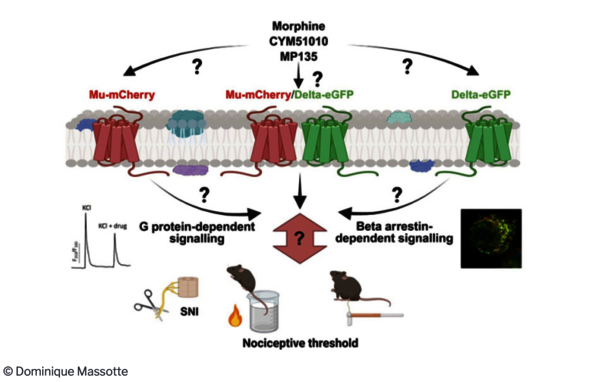
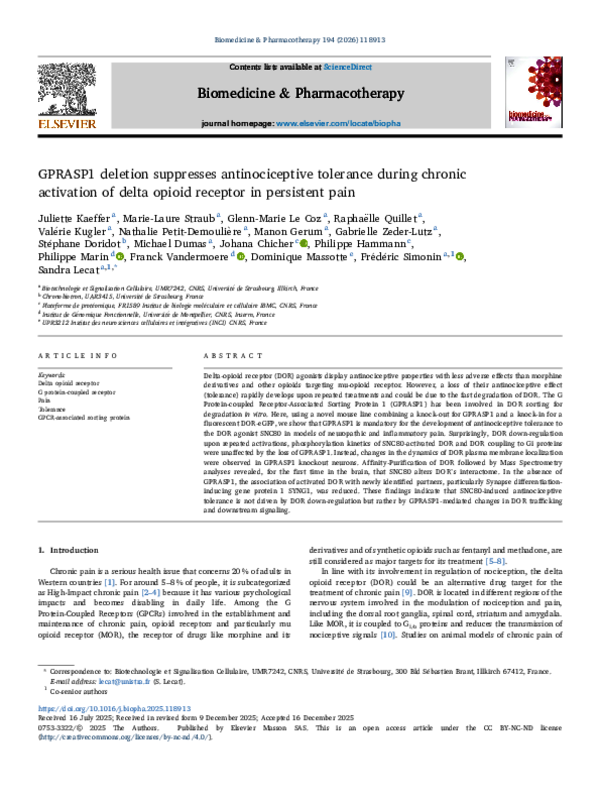
The “Opioid System, Nociception & Pain” team, led by Dominique Massotte, begins 2026 with three major publications in the field of pain neuroscience: “Divergence in Mu and Delta Opioid Receptor Pharmacology in Neurons and Antinociceptive Efficacy in Neuropathic Pain: Insights from MP135 and…
New scientific publication by a EURIDOL post-doctoral researcher: Impact of aging on pain tolerance
We are pleased to announce that Julia Devanne (PhD), clinical neuropsychologist and postdoctoral researcher with the Life Adversity and Pain team led by Pierrick Poisbeau at the Laboratory of Cognitive and Adaptive Neuroscience (LNCA, CNRS UMR 7364) in Strasbourg, has just published a major article…
New contribution from EURIDOL in Le Figaro Santé!
The February–March–April 2026 issue of Le Figaro Santé features a special report on pain. Pierrick Poisbeau, a team leader at EURIDOL - Graduate School of Pain, contributes to the section entitled “Being Yourself” on chronic pain, alongside other specialists.This feature highlights a striking…
EURIDOL experts featured in the latest edition of Science & Vie!
The special edition of Médecine de Science & Vie (March 2026) features an exceptional report on pain: biological mechanisms, therapeutic innovations and clinical perspectives. Entitled “Overcoming pain – New avenues for scientists”, this issue highlights major advances in the field. This special…
Publication: Médecine de la douleur
Edited by Pierrick POISBEAU and Meggane MELCHIOR. Physiological and pathological mechanisms of pain and analgesia.
Publication in eLife: a study by an EURIDOL team!
EURIDOL is pleased to announce the publication in the journal eLife of the article entitled “Affinity-guided labeling reveals P2X7 nanoscale membrane redistribution during BV2 microglial activation”, now available in its final version (version of record). This work was carried out by the Ion…
Identification of bacterial lipopeptides as key players in irritable bowel syndrome (IBS)
"Objectives Clinical studies revealed that early-life adverse events contribute to the development of IBS in adulthood. The aim of our study was to investigate the relationship between prenatal stress (PS), gut microbiota and visceral hypersensitivity with a focus on bacterial lipopeptides…
Modulation of GABAergic Synaptic Transmission by NMDA Receptors in the Dorsal Horn of the Spinal Cord
"The dorsal horn (DH) of the spinal cord is an important structure involved in the integration of nociceptive messages. Plastic changes in the properties of neuronal networks in the DH underlie the development of analgesia as well as of hyperalgesia and allodynia in acute and chronic pain states.…
The Human SCN9AR185H Point Mutation Induces Pain Hypersensitivity and Spontaneous Pain in Mice
"The voltage-gated sodium channel Nav1.7 is encoded by SCN9A gene and plays a critical role in pain sensitivity. Several SCN9A gain-of-function (GOF) mutations have been found in patients with small fiber neuropathy (SFN) having chronic pain, including the R185H mutation. However, for most of these…
Evidence of Sexual Dimorphism in Pain: A Dialogue Between Macrophages and Sensory Neurons via the IL-23/IL-17A/TRPV1 Axis Is a Prevalent Generator of Mechanical Allodynia in Females
"Chronic pain is a very disabling disease, which statistically affects women more than men. More and more studies are looking at this sexual difference. In particular, the study by Luo et al., published on September 1, 2021, highlights a particular neuroimmune axis that induces mechanical pain…
Morphine-3-Glucuronide, Physiology and Behavior
"Morphine remains the gold standard painkiller available to date to relieve severe pain. Morphine metabolism leads to the production of two predominant metabolites, morphine-3-glucuronide (M3G) and morphine-6-glucuronide (M6G). This metabolism involves uridine 5′-diphospho-glucuronosyltransferases…
Impact of COVID-19 on chronic pain structures: data from French national survey
"Aims: The authors evaluated the impact of the first COVID-19 pandemic wave on French chronic pain structures (CPS). Methods: An online survey assessed CPS resource allocation, workflow and perceived impact on patient care. Results: All CPS workflow was severely impacted by the reallocation of 42%…
Behavioral characterization, potential clinical relevance and mechanisms of latent pain sensitization
"Chronic pain is a debilitating disorder that can occur as painful episodes that alternates with bouts of remission and occurs despite healing of the primary insult. Those episodes are often triggered by stressful events. In the last decades, a similar situation has been evidenced in a wide variety…
Inhibitory interneurons with differential plasticities at their connections tune excitatory–inhibitory balance in the spinal nociceptive system
"Networks of the dorsal horn of the spinal cord process nociceptive information from the periphery. In these networks, the excitation–inhibition balance is critical to shape this nociceptive information and to gate it to the brain where it is interpreted as pain. Our aim was to define whether…
Anti-TNF-α Therapy as a Potential Treatment for Comorbid Pain in Post-traumatic Stress Disorder
"Post-traumatic stress disorder (PTSD) is a psychiatric disorder that occurs after exposure to a traumatic event. Chronic pain is one of the most frequent comorbidities for patients with PTSD and higher levels of the proinflammatory cytokine tumor necrosis factor α (TNF-α) have been detected in…
Antiallodynic action of phosphodiesterase inhibitors in a mouse model of peripheral nerve injury
"Neuropathic pain arises as a consequence of a lesion or disease affecting the somatosensory nervous system. It is accompanied by neuronal and non-neuronal alterations, including alterations in intracellular second messenger pathways. Cellular levels of 3′,5′-cyclic adenosine monophosphate (cAMP)…
High-Throughput Screening for Extracellular Inhibitors of the FLT3 Receptor Tyrosine Kinase Reveals Chemically Diverse and Druggable Negative Allosteric Modulators
"Inhibiting receptor tyrosine kinases is commonly achieved by two main strategies targeting either the intracellular kinase domain by low molecular weight compounds or the extracellular ligand-binding domain by monoclonal antibodies. Identifying small molecules able to inhibit RTKs at the…
Investigating cold Aδ fibers in the 0-40 °C temperature range: A quantitative sensory testing and evoked potentials study
"Objective To evaluate the activity of cold Aδ-type fibers to thermal stimuli above human skin temperature (i.e., >32 °C). Methods Twenty young adults aged 20–24 years participated in this study. The cold-detection threshold was measured from a basal temperature of 40 °C using an adaptive…
Photo-isomerizable tweezers to probe ionotropic receptor mechanisms
"Ligand-gated ion channels (LGIC, also referred to as ionotropic receptors) are important transmembrane proteins that open to allow ions to flow across the membrane and locally modify the membrane potential in response to the binding of a ligand. For more than a decade, a tremendous effort has been…